
INSIGHT: Blade failures - a growing driver of offshore wind insurance claims costs
By LUKAS CARBOL - Claims Manager and MORTEN HANDBERG - Lloyd Warwick International
NIORD’s claims data shows that blade losses have quietly become one of the most significant sources of insurance claims in offshore wind in recent years.
To explore why blade losses are escalating and what sits behind the numbers, NIORD invited recognized blade expert Morten Handberg, from Lloyd Warwick International, to co-author this article.

Co-Author Morten Handberg
Morten’s experience (including a period as a Chief Blade Specialist) brings valuable engineering and practical perspectives into NIORD’s claims-data-driven findings.
In addition to examining the drivers behind the growing insurance costs in this article, NIORD, together with Morten Handberg, will follow-up on this topic at the upcoming Bergen Wind Academy, to be held June 17th and 18th.
Are you keen to learn more about the assessment of whether and how blades can be repaired, or how lightning protection systems work? Feel free to join us!
An evolving offshore wind loss profile
Since entering the offshore renewables segment in 2018, NIORD (which operated under the parent Norwegian Hull Club name until 2024) has consistently tracked claims development across offshore wind projects worldwide. NIORD’s dataset covers approximately USD 1.4 billion of settled or reserved claims costs on a 100% basis net of deductible. It reflects claims since 2018 within NIORD’s portfolio, participating on the insurance of around 80% of all operating offshore wind farms outside China, as well as the majority of construction projects.
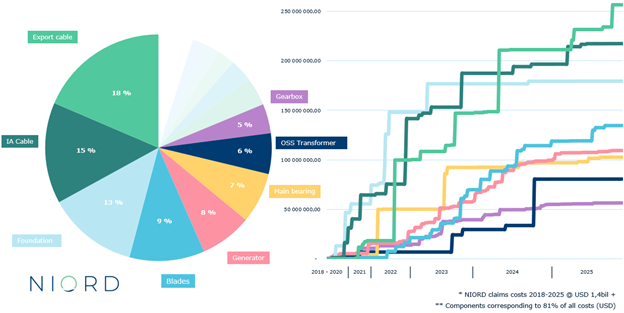
Figure 1: NIORD net claims costs on 100% basis per component 2018-2025
This dataset, reflecting costs from both physical damage and loss of revenue policies, assists NIORD with tracking claims distribution across events that resulted in a claim, as well as across major components including causation. While cable-related losses (inter-array and export) have remained the largest contributor throughout the entire period, their combined share on all claims since 2018 has gradually stabilized at about 30-35%.
At the same time, other components have become increasingly influential in shaping overall loss outcome. Most notably, recent years have seen a clear increase in blade-related losses, elevating blades from a secondary concern to one of the most material contributors to claim costs across NIORD’s portfolio.
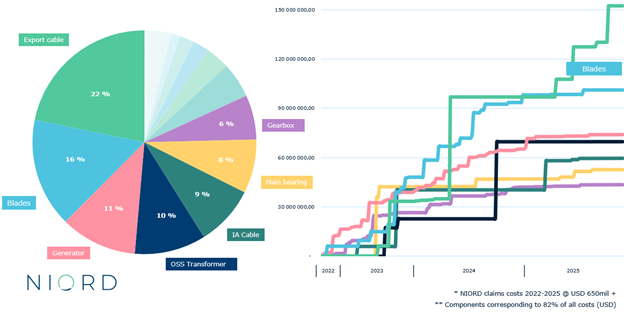
Figure 2: NIORD net claims costs on 100% basis per component 2022-2025
A changing loss profile - the rise of blade-related claims
NIORD’s claims statistics show that blade-related losses have increased both in absolute terms and relative to other components. When looking at the period from 2022 to 2025 in particular - with claims worth over USD 650 million - blades represent a significant and growing share.
This development represents a shift in the offshore wind loss profile. Historically, blade failures were not considered a dominant insurance exposure compared to cables or major drivetrain components. Recent data, however, suggests that risk associated with claims costs on blades now warrants much closer attention.
What is behind the changes?
There has always been an inherent risk of damage to offshore wind turbine blades. Lightning-related damages recorded by the Original Equipment Manufacturers (OEM) and operators commonly manifest as delamination or splitting of the trailing edge. These damages were manageable and often took second billing to more immediate concerns regarding leading-edge erosion that affected the entire asset. Defect-driven damage mechanisms also emerged - in some cases occurring before expiry of the original warranty period. For many years these damages rarely resulted in a claim, as the damage would have been below deductible and repair costs were, therefore, covered by the operator or the OEM under warranty.
What has changed in the global wind industry is the timing and severity of damage. Significant damage is now occurring much earlier in a turbine’s operational life. The claim data shared by NIORD shows a clear uptake in blade claims in 2022. Although the amount of claims may have accelerated around 2022, the underlying issue originates in the early 2000s, when the use of carbon fibre as a primary load‑carrying laminate was introduced into blade structures.
A key driver in the increased size of claims is the optimization of blade design and, as mentioned, the adoption of carbon fibre as a primary load-carrying laminate. While carbon fibre enables longer blades, damages involving carbon-based laminates have a high probability of requiring a blade replacement. This is either due to large-blade repairs in carbon being considered as not technically feasible, or the commercial cost of the repair being higher than that of a new blade.
This evolution represents a structural shift in risk rather than a short‑term anomaly, something that we as an industry need to be mindful of, as the majority of offshore windfarms are still in their early operational life.
Understanding the drivers behind blade losses
A breakdown of claims costs on blades according to causation reveals several major contributors lead by lightning with 25%. Workmanship and manufacturing defects account for 15% and 11% respectively. This is substantially less than the overall claims experience across all components, where defects account for more than 50% of all insurance claims costs. Human error - a category where typical damage would result from handling or installation of blades - accounts for 18%, a fairly substantial share. The overall picture is in constant development. This is apparent from losses, where cause still remains under investigation, which account for 30%.
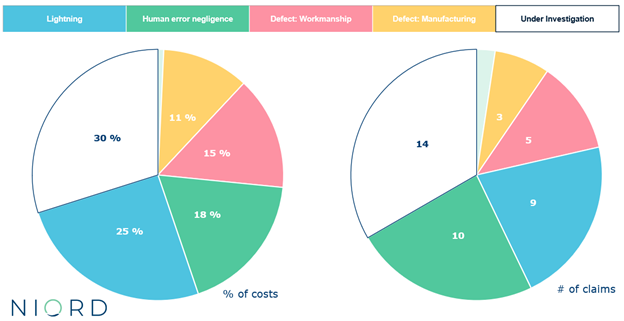
Figure 3: Causation of blade failures 2022-2025 - 100% net claim costs vs. number of claims
Lightning as the prevailing cost contributor
In glass fibre blades, inboard lightning attachment was a very rare event, and lightning attachment direct to the spar cap was regarded as unlikely. Therefore, the vast majority of lightning damage in glass fibre is repairable.
This is partly because lightning primarily interacts with the blade’s lightning protection system (LPS), while the glass‑fibre laminate acts as an insulator. This makes LPS the most attractive part of the blade for a lightning strike. The introduction of carbon fibre in blades changes how lightning interacts with the blade structure.
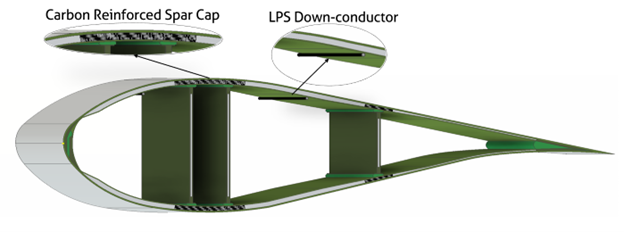
Figure 4: Illustration of carbon reinforcement in blades
In a carbon fibre blade, the carbon reinforcement interacts with a lightning strike in parallel with the blade’s LPS. This means that the carbon laminate itself is susceptible to lightning attachment. In an attempt to counter this, the OEMs have developed different solutions to protect the LPS and reduce the risk of lightning damage to the carbon spar.
The reality, however, is that carbon laminates are being damaged by lightning and direct damage to a carbon spar cap is more likely than to one made of glass fibre. The cost of damage to carbon blades is also significantly higher compared with glass fibre blades, as it often requires full blade replacement.
With increasingly taller turbines and the widespread introduction of carbon fibre as the primary load carrying laminate, lightning-related damage will continue to accelerate in terms of operational costs and insurance claims, as evident from the analysis shared by NIORD.
Human errors during transport, handling and installation of blades
The risk of damaging blades during transport, handling or installation has always been inherent to both offshore and onshore wind industry.
While the frequency of damage related to transport and handling has not changed significantly overall, the cost associated with the required repair has increased. This is, in part, due to increased costs in the industry and less conservative blade designs.
Defective manufacturing and workmanship
The offshore market has been dominated by the major OEM’s and, as a result, offshore projects have not historically been affected by quality issues in the same way as onshore projects. However, recent blade failures in the U.S. offshore sector have challenged the perception that offshore turbines do not experience the same blade quality issues as onshore blades.
Geographical specifics
NIORD registers blade-related claims across multiple regions including Europe, Asia and North America, as well as across different weather regimes and operating environments. Recent claims experience on several individual losses has highlighted some regional specifics which have affected, and may in future affect, the final magnitude of a claim.
In East Asia, we have seen that claims in Japan or Taiwan have been impacted by challenges related to the locally available marine spread. In Taiwan, the issues are more of a political character, while the difficulty in Japan is linked to the full utilization of the currently available heavy lift tonnage and cabotage rules. This has resulted in a shortage of Japanese-flagged jack-up vessels capable of conducting major component exchanges, such as replacement of blades. Recent experience has shown that charter rates and lead time of such vessels in Japan may be significantly higher and longer than standard rates in Europe.
Similar to Japan, implications of the Jones Act in the U.S. are expected to have a significant impact on costs of claims requiring engagement of specialized vessels.
Considering lightning specifically, an analysis of geographical lightning risk conducted by Vaisala indicates high lightning activity in regions such as the U.S. East Coast, Japan, Southeast Asia and Australia. In these regions, lightning damage to wind turbine blades is a known onshore issue. The primary driver of lightning-related blade damage is not the peak amplitude of individual strikes but the quantity of strikes over time. This risk increases for turbines equipped with carbon-reinforced blades, where lightning damage will have a significantly higher severity. Therefore, lightning-related blade damage should be considered both as an inherent risk in specific geographical regions and as a material factor when assessing potential blade-damage claims.
Key observations
NIORD’s claims data indicates that blade losses have evolved from a secondary risk to a material driver of offshore wind insurance claims. Leveraging the depth of our claims database, we have traced the rise in blade-related claims back to 2022, when blade losses attracted little attention within the insurance sector. In line with the points discussed in this article, the shift appears to be linked to increasing turbine and blade sizes, as well as fundamental design changes of blades. The most influential design amendments appear to be the widespread use of carbon fibre as a primary load carrying material rather than glass fibre.
While lightning remains the dominant cause of blade losses - now interacting more severely with modern blade structures - handling, installation and defect-related claims continue to contribute to the overall loss profile. Claims’ costs are further amplified by regional constraints on vessel availability and regulatory frameworks.
Together, these factors underline that it is no longer just cables, generators and gearboxes that are the main drivers of claims in offshore wind. Accordingly, blades should be regarded as a focus for all professionals within offshore wind insurance.
Harnessing claims data with NIORD
The observations discussed in this article are a result, and an apt example, of our commitment to integrate claims experience into NIORD’s everyday operations. This dedication has been fundamental in developing a comprehensive claims database specifically designed for offshore wind. Recognising its value, as well as the importance of knowledge sharing, NIORD consistently seeks to provide valuable insights to projects and their stakeholders.
Are you interested in offshore wind claims trends or how NIORD’s database can benefit your project? Feel free to reach out to the NIORD team!
Co-Author

Lukas Carbol
Claims Manager
lukas.carbol@niord.com
+47 989 92 873